 TAROT
TAROTThe Hermit
Upright
Seeking a new perspective through solitude and intuition.
Personal growth and development to the exclusion of everything else for a short period; finding your own way.
Taking a time out of a busy lifestyle to reflect on what is really important.
Trusting your own inner voice.
Intuition
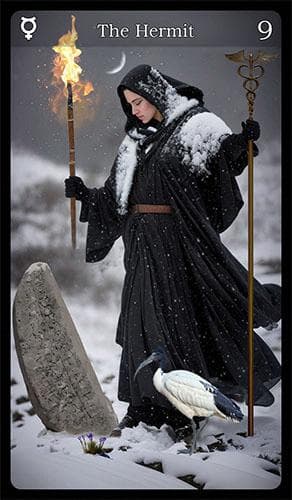
The hermit in this deck is not old, showing that the journey travelled is more important than age.
This hermit has travelled a long distance as he looks to be ancient Egyptian, yet he is on a snow covered peak.
Reversed
Lack of direction, stagnation.
Isolation and detachment, prone to delusion through lack of balance or clarity.
Obsession with esoteric concerns at the expense of the here-and-now.
Astrologia
Analytical and practical with high discipline. Highly loyal with strong humanitarian traits. Perfectionist. Can be over-critical of others. Prone to anxiety.
The Hermit
Unlike other cards so far, the Hermit does not represent an emotion or a state of mind, nor does it represent a physical journey. It represents a period in the natural cycle of life: rejuvenation.
The card's imagery implies a spiritual awakening after a long journey of isolation. A more modern translation might simply be 'taking time for yourself'.
The Hermit is about taking stock of where you are in life based on your own values. It involves repair and refocus. It does not mean retail therapy or a family holiday, but dedicated time on your own. If physical seclusion is not possible, it demands internal soul-searching and less time spent engaging with the outside world.
What the Hermit finds on his journey may be earth-shattering for others. He holds a torch that lights his own way, but this serves as a beacon for others to follow his path.
This may sound vague or 'new-age', but the reality is that the Hermit signifies a vital period where you reappraise your life before moving into a new phase. It can precede major, far-reaching changes, achieved by deeply thinking through purpose and goals.
Hermes Trismegistus
The standard Hermit card typically shows an unnamed old man on a mountain peak, signifying the highest level of enlightenment.
This deck takes a different approach. It does not use nameless archetypes, instead utilizing the earliest well-known, distinct figures on the basis that they form the root of the archetype.
The Hermit in this deck is one of the most influential ancient names in western occult thought: Hermes Trismegistus (Hermes thrice-great). He is a syncretic character that is the combination of the gods Hermes and Thoth, and a Hellenic period author of many source occult texts.
The core concept bridging Hermes, Thoth, and Hermes Trismegistus is all three act as messengers between the gods and humanity.
Hermes Trismegistus is particularly associated with The Hermetica. The Hermetica is not one book, but several different texts written at different times and brought together over time. This presupposes that Hermes Trismegistus is actually a placeholder name for many writers and prophets from antiquity.
These texts are fundamental to Western occultism. Several occult practices are based upon them, including Hermeticism itself, astrology, early astronomy, alchemy, and Hermetic Kabbalah. The latter was practiced by the Hermetic Order of the Golden Dawn. Both Arthur Edward Waite and Pamela Colman Smith were members of this order when they created the Rider-Waite-Smith Tarot deck.
Another thread connecting the practices of astrology, Tarot, alchemy, and Kabbalah is that they all represent the journey of the soul toward immortality. The twelve signs of the zodiac, the Tarot, and the Kabbalistic Tree of Life all map this journey.
Less well-known is that alchemy is also related to immortality. The ability to turn base metals into gold was a way to become rich, but that was not the primary goal. It was seen as an intermediate step toward the true objective: knowing how to transform a mortal soul into an immortal one.
The Hermit on this card is not old, although he appears to have travelled far in his search. This shows that the journey itself is more important than age. Anyone can take the Hermit's path. While enlightenment often takes years, depending on the receptiveness of the seeker, it can also arrive quickly.
Description and Symbology
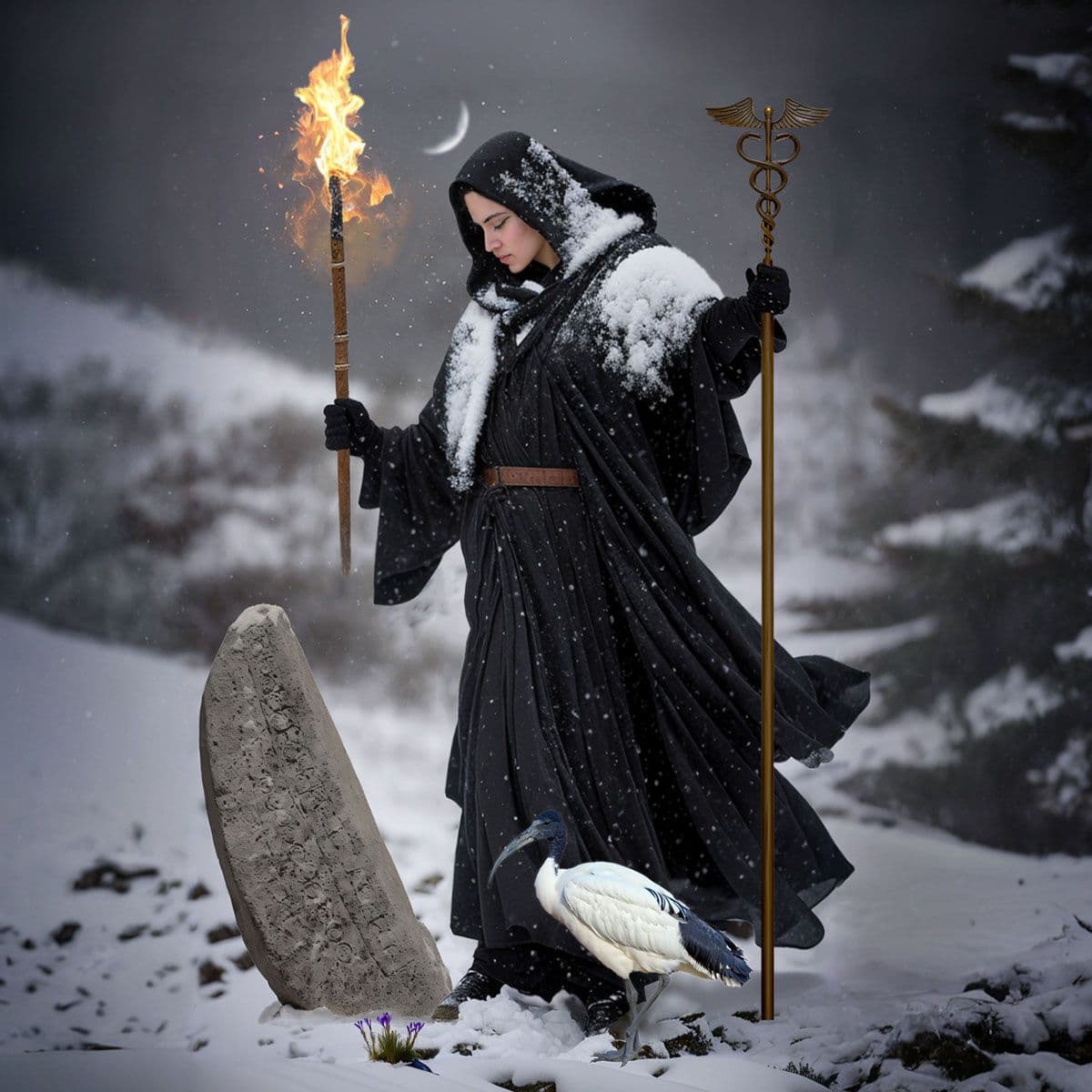
A figure stands in a snowy, mountainous scene. Looking closely at the character’s face, one might initially suspect it is a woman due to the heavy eye makeup. Closer inspection reveals the makeup matches styles used by men in Ancient Egypt, the Levant, and further east. The character is male.
Because this style of makeup was common, he could represent one of several characters from ancient history or early monotheistic religion. If the man came from Egypt or the Levant, he has traveled a vast distance to reach this snow-swept, rocky peak.
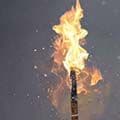
The man holds a torch in one hand (the historical period being too early for lanterns). The image contains numerous references to both Hermes and Thoth.
- Hermes: The man wears a traveler’s cloak, carries a caduceus, and crocus plants grow through the surrounding snow.
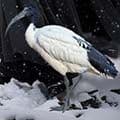
- Thoth: The man possesses Egyptian features, accompanied by an African sacred ibis. A moon sits in the sky, but it lacks the depth of focus seen in the rest of the scene, implying it is hovering directly above the man’s head (in line with traditional depictions of Thoth).
- Divine Messengers: Both gods act as messengers between the divine and humanity, suggesting the Hermit’s end goal involves connecting to higher knowledge.
- Soul-Guides: Both gods are also involved with the afterlife. Hermes was a psychopomp (a guide for the souls of the dead), while Thoth was involved in judging them. The Hermit’s journey touches on the soul’s path after death, demanding reflection on one's self-worthiness for that journey.
The man looks down at a stone slab in the ground. It appears to be the goal of his long journey, and it carries a dual meaning:
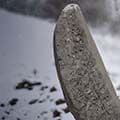
- Ancient Knowledge: The stone bears strange, very old glyphs. The goal of the journey was finding this lost knowledge. This is the message of the Upright card.
- The Gravestone: The slab also resembles a grave. In this context, the man has arrived at a grave symbolizing a spiritual death: yours. This is the message of the Reversed card.

The Hermit's Symbol
The Hermit's symbol is the symbol of his associated planet; Mercury. Mercury is the Roman version of Hermes.

The road less travelled
The Hermit has travelled a long way in search of something important.
Guide for others
The Hermit carries a torch that both paves his way and illuminates his path for others to see.

Symbols of Hermes
There are several symbols that suggest links with Hermes, including the traveler's cloak, the Caduceus and crocus plants growing nearby.
Symbols of Thoth
There are several symbols that suggest links with Thoth, including the man’s ancient Egyptian features, his moon-halo, and the ibis near him.
The stone-tablet/soul-grave
The man looks at, or is in contemplation of, a large stone tablet. The tablet has strange glyphs across its surface. It either represents hidden knowledge that the hermit set out to find, or the observer’s grave.
Tips for Readings
The following table shows the upright and reverse meanings for general questions. The last row ('Yes/No') is useful when you are picking a single card to decide a yes or no decision.
Upright
Reversed
A need to find yourself before considering relationships.
Relationships are not a focus, and for existing relationships there may be a need for a period apart.
You may also see your main relationship to be with a much larger group; the larger family group, a larger set of people, or even humanity itself.
This period will result in positive gains for the long term.
Retreating from others (or having goals that conflict with having or maintaining relationships) may be harming your chances.
This may not be a bad thing, but make sure your priorities are correct!
Work is either not a focus, or not your main priority.
You may be stepping sideways into a tutoring role at work or taking time out from work and have bigger personal goals in mind.
These may include education, charity, time out via a sabbatical or dealing with personal problems.
This card agrees that work is not your priority at the moment.
An inward looking mindset has made you a dreamer.
Lack of focus in any group activities, and reduced performance at work.
Suggests a period of removal from the everyday that results in rejuvenation.
This may or may not be planned, but it will eventually be for the good in terms of health and peace of mind.
You are ignoring the body in preference to the mind, meaning you have larger goals than personal health.
That is fine, but make sure you are not neglecting yourself!
A strong period of personal growth, and often the only focus of the period signified by this card.
You will most likely spend a period away from material, emotional and health concerns and think more about your inner growth (or the growth of others). This may involve spiritual leanings, but may also be a period of healing after a hard period in your life.
Recuperation and rest.
There may be a sense of helping others or leading others in a spiritual/teaching/tutoring role.
Delusional or lack of balance between spiritual concerns and the here-and-now.
Are you hiding into a world of idealism (or blame) vs reality? If so, it may be better to use the time recuperating on ‘lessons learned’ then wiping the slate clean rather than setting the world right!
Not an area of focus as there is a much lower focus on material concerns.
Avoid making decisions, but be aware of the cost benefit if you choose to ‘drop out’ for a while.
You will see money as irrelevant to the current aims (or current issues on your mind).
This may lead to waste and poor decision-making.
Uncertain.
Uncertain.
Reading the Card
Hermes Trismegistus appears in his other forms (Hermes, Thoth) in two other cards: Judgment (as Hermes) and the Page of Wands (as Thoth). All three cards represent a change to yourself:
- The Hermit: Finding your way through introspection.
- Judgment: Looking at your own actions and their outcomes.
- Page of Wands: A thirst for knowledge and ideas, and their use in changing your life.
Looking at these three cards together may make learning them easier.
The Upright Card
The Upright Hermit suggests a time of reflection and finding your own truth. Although the figure on the card has embarked on a long pilgrimage to find a spiritual truth, in modern life, there is no need for such an extreme journey. The actions suggested by this card can be as simple as taking time off from a busy lifestyle or a day job to reflect on what is truly important.
The upright Hermit card suggests a time of inner reflection and finding your own truth.
It can also suggest spending time addressing something that is very personal to you and affects nobody else, but has been put off for a long time.
The core message is to take time to be alone with your thoughts: re-analyze, recharge, and come back stronger with a fresh message or new meaning to your life.
The Reversal
The Reversed Hermit represents the need to step back and find your own voice, but it indicates a lack of time or motivation to do so. It can mean you are listening to other people’s voices rather than your own, causing conflict with your self.
If allowed to grow, this situation leads to a lack of direction or profound disillusionment. It represents the feeling of completing a task on someone else’s terms, but you are 'just not feeling it': the success does not truly align with what is important to you.
It can manifest as a feeling of hollowness. You do not know what the purpose of something is, or you do know, but it simply does not speak to you, a common situation in many jobs that are 'just done for the money'.
The Reversed Hermit tells you to stop running just to keep up, and take some time to reflect. Is this really you? Is this what you really want?
It is time to stop and think.
Card Design Process
This card was set aside until the Christmas period, and was designed and implemented during that time.
Perhaps every Tarot deck should have its 'Christmas card'.
Final Words
The Hermit is a reminder to trust in yourself and seek answers from within before making any major decisions or changes in your life. If the answers are not there, take time to retreat and find your authentic inner voice.
You will then come back with real targets, goals, and a deep understanding of what success and failure truly mean to you.