 TAROT
TAROTSix of Cups
Upright
Old friendships, nostalgia, and gratitude/appreciation. Safety
Joys and experience of the past.
Giving and receiving kindness.
Innocence and trust.
Letting go of responsibilities and enjoying life’s pleasures as a child for a while.
Intuition
The card depicts one of the oldest Love stories (and possibly the source material for Romeo and Juliet); Pyramus and Thisbe.
Reversed
Denial, difficulty in living in the present, selfishness, unresolved issues with the early past.
Living in the past.
Hiding from present responsibilities.
Immaturity and lack of growth.
Problems with giving/receiving and fair share.
Astrologia
Determined, Intense and passionate. Transformative, with strong ability to self-introspect regarding current feelings or formative events from the distant past. Can be secretive and destructive.
Six of Cups
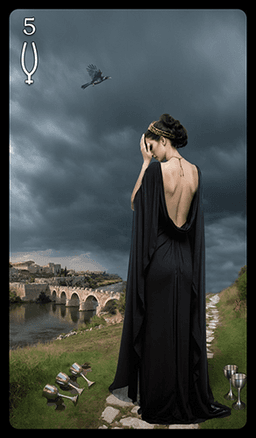
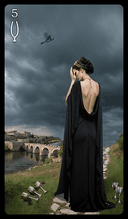
The previous card, the Five of Cups is about being stuck in the past through traumatic memories or events. The Six of Cups changes the connection with the past to a pleasant one: better times, a more carefree existence, or rediscovering past connections.
It can mean negating the memories of a bereavement or disconnection by carrying yourself into the future by remembering earlier, better times.
It can mean looking at the future through a child’s eyes, seeing the potential and ignoring the immediate ‘it won’t work’ pitfalls of an adult’s eyes.
it can also mean ignoring present responsibilities by living in the past. This does not mean literally behaving like a six-year-old. It means abdicating responsibility, such as ignoring unpaid bills in the hope that not thinking about them will make them disappear (a more prevalent adult belief than many suspect).
Pyramus and Thisbe
The story of Pyramus and Thisbe dates to Ovid’s Metamorphoses (around 8 CE), but that is only the earliest written version we have. The story is derived from a much earlier version that comes from the East.
They are the archetypal young lovers, inspiring countless later stories (including Romeo and Juliet). The myth follows a boy and a girl, Pyramus and Thisbe, born in adjoining houses. They become familiar with each other as children. As they grow older, childish companionship blossoms into love, but their fathers forbid them from seeing each other.
Young love finds a way. Here, it is the smallest hairline crack in the wall between their houses. The two lovers spend their time whispering through the crack. Unable to see or touch one another, they prove that the gift of love can pass through the smallest space.
Eventually, they come of age and agree to elope, planning to meet under a tree outside the city. Thisbe reaches the tree first but sees a lioness approaching. She runs and hides, but in her haste, drops a veil. The lioness sniffs and shreds the cloth.
When Pyramus appears, he finds only the bloodied, shredded cloth. Believing his love has been devoured, he is grief-struck and falls upon his sword.
Thisbe returns and finds the dying Pyramus. She joins him in death, taking his still-warm blade.
Sometimes people need to listen to the voice of the child, because it can be childish and full of fantasy, but when it is said earnestly and from the heart, it is spoken from a place of unshakable truth.
Sometimes people need to listen to the voice of the child.
Description and Symbology
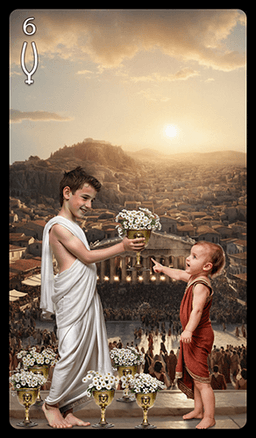
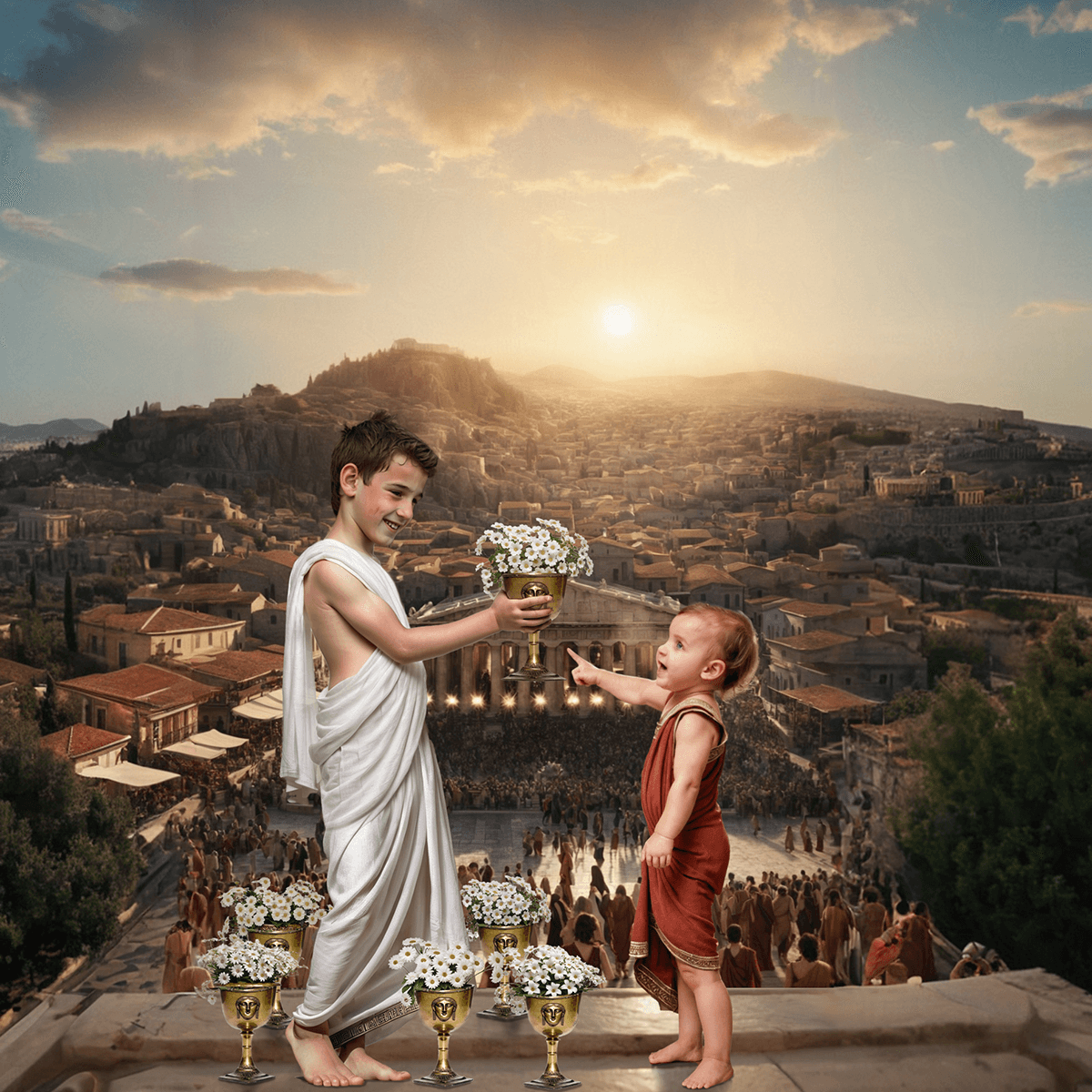
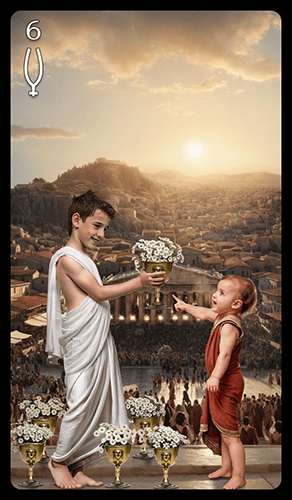
We see two children: a boy and a girl. The boy hands the girl a cup filled with blooming flowers, suggesting deep affection. There are more cups waiting to be given, implying a lasting relationship.
The cups can represent a physical gift, but more likely represent a transfer of care, help, or affection. As noted in the myth, affection can find the recipient through the smallest space and over the longest distance. A hairline crack in a wall is all it takes.
The boy gives with a smile and no airs. The girl receives with the innocence and joy of a child. This simple exchange strengthens their bond. It is clear that both children receive something profound from the act of giving.
This is the nature of pure giving and receiving. Both love and hate are gifts you give. Only one is received with thanks; the other is always returned.
Finally, we note that both children are in a raised area out of reach of the masses below. This shows they are in a position of safety and can grow as children without the worries of the adult world below them (in other decks this concept is shown by a town guard).

The act of giving
The boy gives with the innocence of a child. The act of giving without pretensions makes him happy, suggesting goodwill is an act that benefits both the receiver and the giver.

The act of receiving
The girl receives the gift with childlike innocence and happiness. Giving can be difficult, but it can also be difficult to receive help because it can be seen as a personal failure or the weakness of need.

The child-like purity of affection or care of others
The boy and girl are both happy through the simple things: a space to grow, and each other.
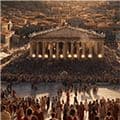
The bustling city around the children
The two children are removed from the bustling city below them. They are allowed to grow in an area of safety. The environment any relationship grows in is as important as the relationship itself.
Tips for Readings
The following table shows the upright and reverse meanings for general questions. The last row ('Yes/No') is useful when you are picking a single card to decide a yes or no decision.
Upright
Reversed

This card relates to the past, and this could be good or bad. If you are in a long relationship, it suggests connecting deeply by revisiting your earlier years when there was greater co-operation and closeness. One or both partners may have feelings of being taken for granted.
It could suggest that one partner is being immature, or it could mean that one partner has other things bearing down on their thoughts.
For those looking to have children then along with other cards, it could suggest a new addition.
For those who are single, it suggests a potential new partner will come into your life from the past.
A longing for the past or incidents from the past may be holding you from moving forward in relationships.
Addressing the past and learning from it rather than replaying it constantly is the best way forward. Without this, the present and future will be shaped by poor outcomes from the past, and an equally poor future will occur.
It is particularly important to see things as an older and wiser adult. Youth may have been more exciting, but that’s because it has a safety net (which disappears once you are older!).

Spending time paring back the complexity of your career and finding simplicity may work well. Asking basic child-like questions such as ‘what is wrong?’, ‘what is right?’, and ‘am I happy?’ will be a good start.
Look at whether inertia and familiarity are holding you to the past. The card suggests safety, which can be both good and bad. Are there better opportunities beckoning elsewhere that beat the current feeling of safety at the expense of moving forward faster?
You are relying on past performance or past success, and may be in a safe, well-paid but boring job via ‘golden handcuffs’ or safety-inertia.
Remember, they are keeping you for the project, not for you. Once that ends, the goldilocks period also ends.
It is time to look to the future and remember you are not a tree and don’t have roots. You can get up and follow the sun!
There may also be a sense of wanting promotion for past successes rather than future potential. Watch that as it is a common career miss-step!
Spending more time on the simpler pleasures may help with any health problems you have right now. A walk in the park rather than a night out and meal, or time with significant others at home with a glass of wine rather than travelling to a room full of strangers.
This will not only make you thinner, but it may also make you happier with what you already have!
A lack of moving forward from past habits may be creating problems. When you are six, you can spin around until you are too dizzy to stand, then get up 10 seconds later. Try it at thirty and it’s a day off sick…
This is obvious for most people, but it is not so obvious for partying all night or staying in front of a screen all day!

Revisiting your earliest beliefs will prove fruitful.
It will either prove how far you have moved forward or show you things that you have forgotten and should revisit. Hopefully it will shed light on both.
Another feature this card can signify is charity. It is important to give for the right reasons and be thankful for what you yourself received by paying it forward.
You are clinging to old beliefs or deeply held convictions that hold water from past experience but are acting as blockers for future growth.
It is time to re-analyze the past with the future in mind. Consider what promotes growth and aligns you with the future you want, vs fighting for things that only the younger you considered important.
Things like status-labels vs. self-confidence and fun vs. contentment are obvious, but we all have a few self-defeating ones that take a while to force kicking and screaming into the adult world!

Check your finances for over-complexity or being out of date.
It is quite often the case that you look at a portfolio made even a couple of years ago and can’t remember why you chose certain assets, so check now!
Also, streamlining your choices so you could explain them to your inner six-year-old may be an exercise worth taking (it is amazing how frequently the reason is ‘I’ve kept it because I can’t be bothered to change it, and it does okay so far’!).
You are struggling with debts or bad habits from the past, and they are most likely continuing because the enablers for them are also coming from the past and remain unaddressed.
It is time to remove old childish wants or spending that would be paid at a vague future date, because that vague future date is now, and the child has to admit to growing up!

Yes, through safety and remembrance of the past.
No, through being held back by the past.
Reading the Card
The Upright card generally denotes revisiting the past, earlier innocence, or simplicity. It represents safety.
The Reversed card notes the same process, but warns you are likely stuck in the past. Nostalgia and a yearning for something missing holds you back.
The Upright Card
The Six of Cups is about looking back to your roots, old memories and nostalgia. It speaks of the purity and innocence of a child: honesty (which can be a double-edged sword), curiosity and being forthright with your emotions.
The card sometimes suggests stripping away the trappings of adulthood and seeking simplicity.
Giving everyone a say often leaves you with a contrived, complicated solution. 'You can have one each if you are here, otherwise none' is a sentiment straight from a child who refuses to wait for adult excuses and timetables.
The card can mean bringing the past into the present: reconnecting with old friends/flames, or recalling old emotions by revisiting significant locations or photographs. This does not have to be a rose-tinted, backward-looking exercise; it can be a positive reaffirmation of your roots and how far you have traveled.
Finally, the card denotes safety. In relationships, it represents a period of simplicity. This safety allows close bonds to grow within a new relationship, or strengthen (even regrow) in an existing one
The reversal
The Reversal can mean looking back at your roots for the wrong reasons. You might be hiding from the present or a recent loss by wallowing in nostalgia, or forgiving bad behavior by living in a past world where the offense did not occur.
It can signify childish behavior, such as assuming you deserve things simply because you want them. This is unfortunately a common adult regression.
The Reversal points to deeper concerns, such as being uprooted from familiar surroundings or status and being forced to start again. The card suggests you must rely on your core social network of family and long-standing friends, and you should not be reticent to do so. Asking for help is frequently harder than giving it.
Finally, it can indicate being held back by issues from early in life. This is a powerful blocker, and one to be highly mindful of when reading for someone else.
Card Design Process
The hardest part of this card was capturing the expression of a child receiving a gift. It never felt right until the deck creator asked an expert; their mother. She confirmed that small children do not simply smile. They use their entire body.
They point at the thing that makes them happy, clap their hands, kick, or make noise, and only then begin to smile at the sound of their own happiness.
Once her description was followed, it all suddenly felt right, eliciting a smile when the image was completed.
Perhaps this feeling was remembering.
Final Words
The Six of cups represents the past and the sense of childhood safety, innocence, and memories of growing up. Depending on the context, this can act as a reminder of who you are. It can also be a warning that the old ways only get you so far, and nostalgia can be a trap that prevents you moving forward in the present.