 TAROT
TAROTDeath
Upright
An ending or closure.
The end of a phase in your life that requires letting go and moving forward.
The need to have the courage to embrace the current situation and know there is a brighter future.
Intuition
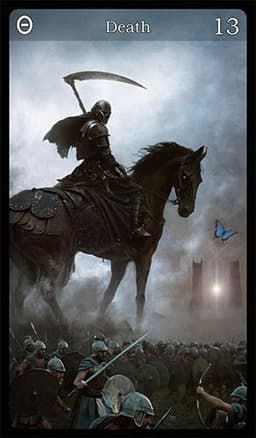
Although this image uses the 13th Century archetype of Death (the Grim Reaper), the rest of the imagery is much more ancient.
The mist is the liminal space separating the living from the dead, and relates to the High Priestess (Hecate)
The butterfly represents the soul as it flies across the liminal space from the living to the afterlife, and relates to one of the two characters in the Lovers card (Psyche or 'mind/soul').
Reversed
You are resisting or ignoring a potentially painful change
Compounding the fallout from an ending via a failure to let go.
Ignoring emerging destabilizing events in your life that will leave you unready when they occur.
Astrologia
Intensity and passion, sexuality, understanding of basic emotions. Loyalty. Resourceful. Transformative change and mystery. Prone to being controlling, jealousy and keeping deep secrets.
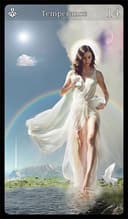
Death
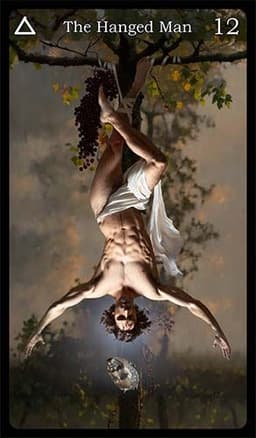
The T-shaped symbol of the Hanged Man’s tree represents Tau: transformation as resurrection and a new beginning. However, the next letter in the Greek alphabet is Theta (the symbol on this card). Theta represents transformation as an ending. This transformation does not normally mean the physical death of the person, but it does mean a finality in some aspect of their life.
Although endings are often feared, remember that we are not talking about literal death, but the closing of one phase of your life. This typically happens to clear the way for a new phase or direction.
The 'death' of something is therefore often welcomed in hindsight. It usually denotes a loss or a purge, but we must let go of one thing to gain another.
This makes Death a positive card, although you must be aware that it can act as a 'wildcard': the thing you thought would be lost is not what is actually lost, and this twist can be unexpected.
The Death card can also denote a fundamental change in you as a person. While the previous card (The Hanged Man) refers to a rebirth, the Death card denotes the strict ending that precedes it. Although the Death card itself does not speak of the new beginning, the surrounding cards in a reading usually will.
In any of its forms, be ready for the ending to be uncomfortable, and perhaps even painful due to the loss. However, there will be better days ahead as that loss is replaced by something else.
Although the ancients worshipped many gods of death, they were all visually superseded by the effects of the Black Death in the 14th century. One-third of the population of Europe perished, and the image of a skeletal figure holding a scythe became the ultimate archetype of this horror: Death harvesting millions of the living as if they were corn in a field.
The Grim Reaper
Although the card uses the symbology of the Western Grim Reaper, it also ties into far older archetypes. Specifically, it connects to the High Priestess (Hecate) and the ancient concept of the Mind/Soul (Psyche, one of the figures in the Lovers card).
Description and Symbology
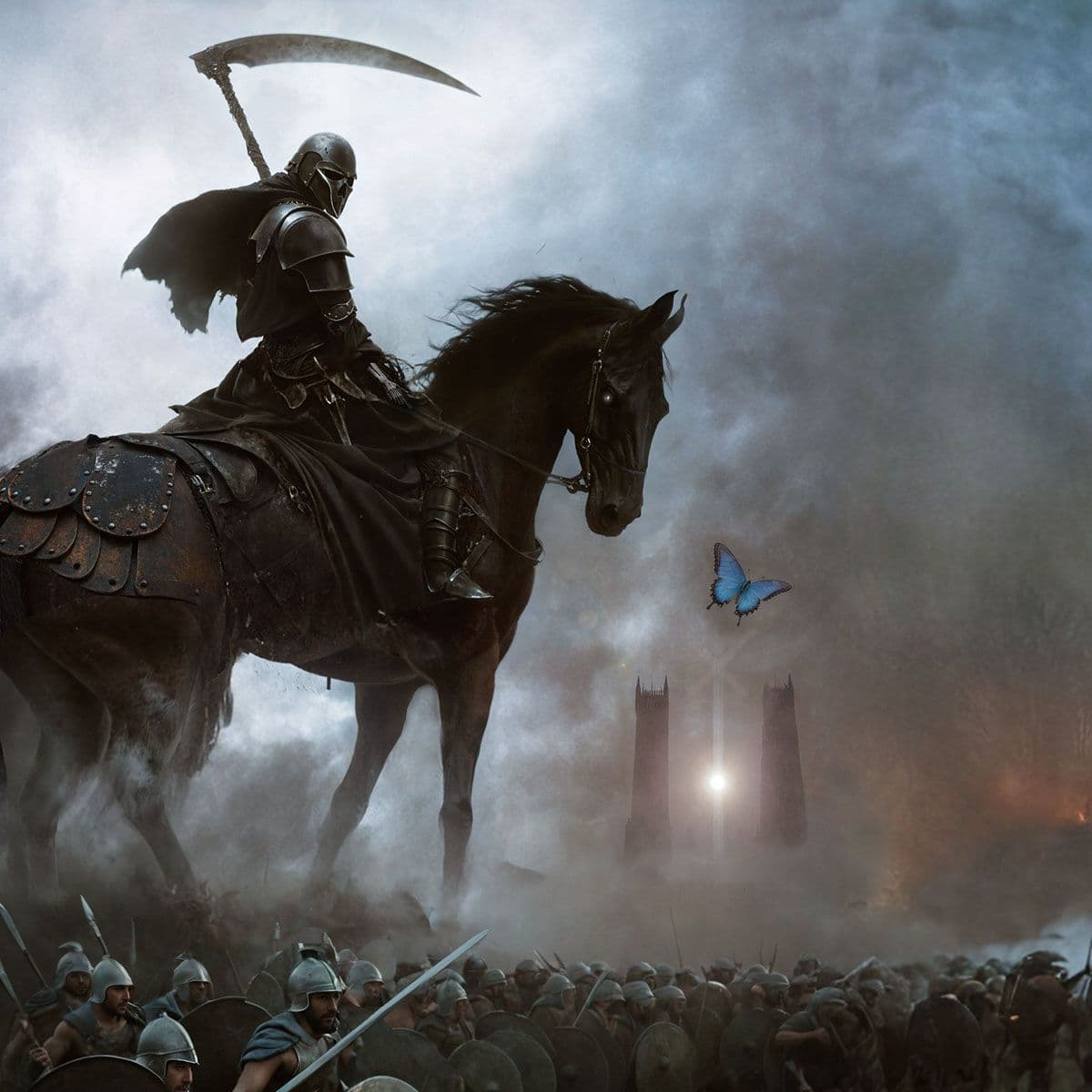
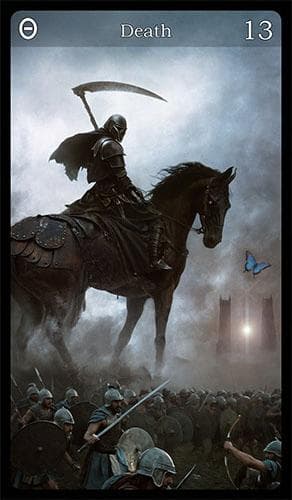
We see Death as the Grim Reaper, a large and unseen specter stalking the battlefield of life on a dark horse, awaiting the casualties. A thick mist rises directly before Death’s horse. Death cannot cross it.
This mist initially looks like the smoke and burning created by war, but is actually a visualization of the liminal space between the living and the dead. For all his power over mortals, Death stops short at this barrier because he cannot cross it; that path is protected by a Higher Power than mere Death.
In front of Death and his horse flutters a butterfly. In the Lovers card, we noted that the butterfly is the ancient symbol for the soul (Psyche).
This butterfly represents a soul moving from our side of the liminal space to the other. The transformation of the soul is likened to a caterpillar, which spends its mortal life with no knowledge of the vast, interconnected reality beyond its current leaf or tree. When it takes wing as a butterfly, its perspective shifts, and the soul finally sees true reality.
Death and his horse quietly watch the butterfly. Despite its fragility, Death cannot touch it because it is protected by that Higher Power. It flies where Death will not follow: it has become immortal.
This liminal barrier is the domain of the High Priestess, Hecate, and she is the Higher Power. This is proven by the shining light between the towers; it takes the exact shape of the torches Hecate carries.
The butterfly reaches the end of its journey in this world as it touches the barrier, flying through to the next world where it will interact with another god: the King of Pentacles. We live for a short while under a mortal king or queen, but we spend eternity under this ruler, making him the richest king of all: Hades.
The soldiers in the scene are oblivious to all of this. They see neither Death nor the butterfly, and they remain unaware of the liminal barrier. They will carry on living their lives until their time comes, and then, like all of us, they too will rise and fly their final journey.
More importantly, the card tells us that Death is only one part of an intertwined journey, and he is not even the most powerful part. That journey is life itself, and Death is not its enemy; he is simply a part of it.
The card illustrates that the soul does not simply cease; it travels to another destination. Although death is seen as closure by those remaining, to the one traversing the barrier, it is simply the next phase of the journey.
Finally, the rising soul is the most beautiful thing in the mortal world for those with the eyes or intuition to see it. In comparison, the rest of the world is merely a monochrome, muddy battlefield.

Card Icon
The card icon is the Black Theta or theta nigrum, a symbol of death in both ancient Greek and Roman Latin. In Greece it was used as an abbreviation of Thanatos (Death), and also used in much the same way as the Skull and Crossbones is used to denote danger today (as it resembles a quick shorthand for a skull). It has also been found in ancient military and other records against dead soldiers.
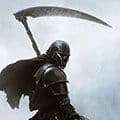
Death as the Grim Reaper
Although later than most archetypes in this deck, the Grim Reaper is the most powerful symbol of death in Western thinking. The Grim Reaper is often shown with a visible skull, but that is perhaps a little obvious through overuse. Instead, the rider is more ambiguous until you spot a bare skeletal hand.
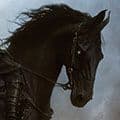
The Horse
The Grim Reaper’s horse looks almost as sinister as the rider and this is intentional; the specification for the card used the phrase ‘a dark horse - nightmare’. If you have a nightmare you are perhaps riding through your subconscious on this horse!
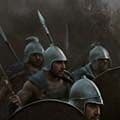
The Battlefield
The Grim reaper is ‘death stalking a battlefield’, and the battlefield symbolizes life itself.
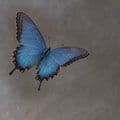
The Butterfly
The butterfly's states from caterpillar, chrysalis to final butterfly were seen as mirroring the phases of human life. At the beginning, all humans think about is physical growth and material nutrition. We see a very small world. A butterfly no longer sees just a leaf on a tree, but the whole forest, and its sole purpose is to complete its lifecycle. A soul in flight is therefore not that different in purpose from the butterfly.
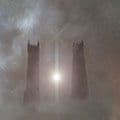
The Towers and mist
As seen on the High Priestess card, two pillars are a ward under the protection of the Goddess Hecate. The two towers represent the largest such ward. Nothing may pass without Hecate’s permission, and passing gives immortality. The tower’s border is denoted by a wall of mist. This is the liminal barrier between the living and dead.
Tips for Readings
The following table shows the upright and reverse meanings for general questions. The last row ('Yes/No') is useful when you are picking a single card to decide a yes or no decision.
As mentioned above, the Death card is unusual in that the thing the Death card refers to may prove to be unexpected, and not the main subject of the question being asked. Reading the Death card often means looking at the cards around it as much (and if not more) than the question being asked.
Upright
Reversed
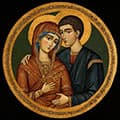
This card represents a significant ending; dissolution of a partnership, or letting go of a relationship that no longer works.
Relationships can be fixed only if old ways of thinking are ditched
You are resisting change in a relationship or partnership.
The Death card suggests being realistic. Let go of things that must pass to allow the future to bring in something new in its place.
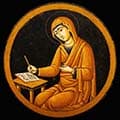
There will be a job loss or a significant change in direction that may be forced or unexpected
This may be painful but necessary for future growth.
The death card in a career context may suggest looking for a new job or change in career. Remember though, death is a prerequisite for rebirth, so it is certainly not all doom and gloom!
Check if you are guilty of inertia. You may be comfortable, but your career may be going nowhere.
Look to new avenues early, as fate may otherwise have a nasty surprise awaiting you if you stay put!
A major change in health that signifies an ending (although probably not actual death).
The card suggests coming to terms with bad news earlier. What will happen will happen but how you feel about it often matters more.
You may have your head in the sand over issues you have been ignoring.
Whatever this is will end in its own time, but will go better if you address and accept it earlier.
This card represents a transition from one mindset to another, and it may well be painful, involving grief and feelings of loss.
On the positive, it may signal an end to grief is imminent, a clearer understanding of the past, and a more forward-looking mindset.
A major upset is looming that you are ignoring.
This card suggests it will be better to address a loss or failure rather than hope for the best, because the best will not happen.
Watch your income streams. One of them may suddenly dry up or change significantly.
It may be time to revisit old investments to see any of them are based on old assumptions; if so, sell them.
There may be a loss of income that you are ignoring and hoping for it to fix itself.
This will not happen. The Death card suggests you need to crystallize losses, take any hit and close the position or income stream.
Yes if the question involves change, no otherwise.
No, due to resisting change.
Reading the Card
The Upright Card
The Upright Death card signifies endings and change in your life. These shifts may be challenging or difficult when they occur, but they will reap rewards in the future. The card advises you to let go of something that has reached finality. Holding on will cause stagnation: living in the past, or trying to keep something that no longer serves a purpose.
This could refer to a relationship, a business, career, or money matters. For these areas, the card acts as a forewarning. For example, if Death appears for a career-related question (supported by surrounding cards), consider whether your current job is secure or fulfilling. You may need to start looking elsewhere. Staying could cause stagnation, or a layoff may be likely.
For health and spiritual matters, the card advises you to be ready to accept change. Hiding from these shifts or ignoring a developing situation will only make it worse.
In all cases, the card represents a break or ending in your current life. It advises that acceptance and moving on are the best course of action. There are better days coming. Although the current situation may be difficult, addressing it now will ready you for future growth.
The Reversal
The Reversed Death card predicts the same endings, but indicates you are clinging to the past and resisting or ignoring the change. This will ultimately result in the same outcome as the Upright card, but your resistance will have a longer, negative impact on your healing and future growth. Consider your position, and whether you would do better by:
- Accepting the loss and adapting to the new situation.
- Confronting difficult truths.
- Realizing that maintaining old patterns will only result in wallowing in grief or clinging to the past.
- Addressing today's pain, knowing it is necessary for a brighter tomorrow.
Card Design Process
The card was designed based on mood boards created from video stills of a modern battlefield ongoing at the time of creation: the war in Ukraine. The soldiers are loosely based on Slavic warriors. The positions and faces are drawn from images of modern soldiers readying themselves for combat.
Death’s horse wears old, rusting armor across its back. This texture is based on the patterns created by reactive armor blocks seen on destroyed modern tanks.
The overall aim of the image was to ensure everything was grey, except for elements of a spiritual or emotional nature. Thus, the butterfly is blue, and the more heroic soldiers also bear touches of blue. The direction of the battlefield and the area around the two towers have warm reds associated with them.
Final Words
The Death card represents endings and change. It predicts significant life shifts that will be challenging, but you must accept and address them to move forward. This is vital: the challenge may bring your darkest day, but after that, the future will be brighter, heralding new beginnings.