 TAROT
TAROTFive of Swords

Upright
Needing to win at all costs
Putting winning an argument or situation over everything else.
A pyrrhic victory caused by winning at the cost of relationships, career, or money.
Putting your principles over the reality of the situation.
Intuition
Some important parts of this card are in the background.
The main character walks away from the body of water, representing walking away from his emotions - his actions are cold.
The sky can’t decide whether it wants to be sunny or stormy - there is no clear winner.
Reversed
The fallout of attempting to win at all costs.
Wanting the argument to end but also having to deal with the fallout.
Reconciliation and coming back together.
Irreconcilable differences caused by the way you conducted yourself during your win.
Astrologia
Emphasis on friendships and platonic relationships. Looks for the unconventional and intellectual in all things. A strong and complex streak of independence in relationships that can result in emotional coldness, or breaking friendships and destroying ties to gain distance in a journey seen as more important than relationships.
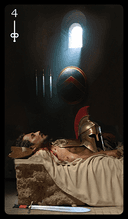
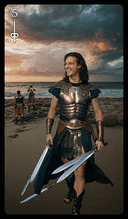
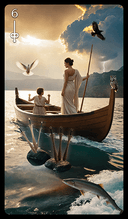
Five of Swords
After the simmering battles of the previous cards we have a victory, of sorts.
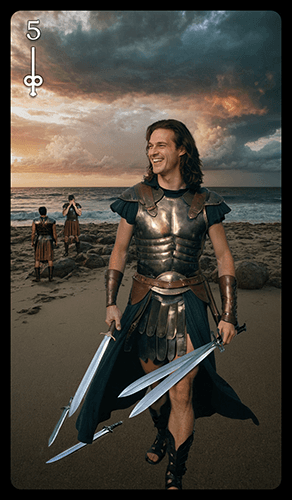
The man in the foreground walks away with three swords, leaving two lying on the ground. Assuming the two swords belong to the men near the water, the victor won by possessing more swords: intellect, ideas, or a stronger argument.
This is not a fight won graciously, nor is it necessarily fair or justified. The victor's expression speaks volumes. He is happy at winning and contemptuous of the losers. His laugh is almost a side sneer in their direction. He will learn to regret this position if he ever needs their help in the future.
The Five of Swords illustrates the Sisyphean archetype, personifying the Absurd Hero. This archetype differs fundamentally from the Fool, who learns and grows. The Absurd Hero is doomed to constantly attempt tasks that fulfill his immediate needs for fame, power, avarice, and ego. For this hero, the prize is everything.
The victor is locked within a cycle that can never be completed by one so wicked or foolish (while simultaneously thinking himself clever). The Absurd Hero constantly hungers for more.
Sisyphus
Sisyphus was the first king of Corinth. He was greedy, immoral, and a trickster.
His first crime was murdering guests at his palace to steal their belongings. This violated xenia (the law of hospitality), constituting a direct crime against Zeus. He plotted against his brother and betrayed Zeus by giving away divine secrets. He also ruled as a cruel and unjust tyrant over his own people.
For these crimes, the gods sentenced him to death. He managed to scheme his way out by tricking death itself (the god Thanatos), and later Persephone (the Queen of Pentacles). Thus he was sly enough to cheat death twice.
Sisyphus’s crimes eventually caught up with him. He had angered Zeus and Persephone's husband, Hades (the King of Pentacles and Lord of the Earth). In death, Hades cursed Sisyphus to roll a rock up a steep hill in Tartarus. Upon reaching the top, the rock immediately rolled back down, forcing Sisyphus to restart.
This task gives us the word Sisyphean; an endless and futile task that will never be completed.
Sisyphus suffered an extreme sense of hubris. Thinking yourself sly enough to cheat the gods of death invites ruin. The gods have all eternity to exact their cold revenge.
Description and Symbology
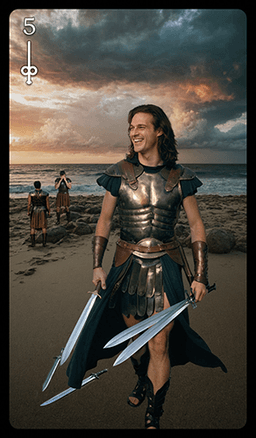
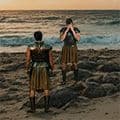
The card depicts three men on a beach. The man in the foreground, Sisyphus, holds three swords.
Two discarded swords lie on the ground. Sisyphus appears to have won a contest by securing the most swords (representing better ideas or arguments). He walks away, looking backward contemptuously at the losers.
Yet all three men wear similar armor, suggesting they fight on the same side. In winning, the victor loses friends and allies. He was so set on winning the immediate battle that he weakened his position for the overall war.
The background forms a core part of the scene. The two defeated men stand closer to the sea. As water represents emotion, they feel the sting of their loss deeply; their body language reflects this despair.
The victor walks away from the water. He ignores the emotional fallout, concerning himself entirely with being right and winning.
The sky reinforces the scene's tension. Half the sky radiates warm sun, while the other half brews heavy storm clouds. The atmosphere remains deeply unsettled.
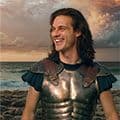
The victor
The victor has won through having the most swords (ideas, intellect). He is however not at all gracious in his victory. This may have lost him the defeated men as allies or friends for the future.
The defeated
The two losing men stand by the water’s edge, signifying their emotional state. Their body language also suggests emotional pain at losing. It is not just the loss that causes their distress (they are after all warriors) but the manner of the contest. They will likely not trust the victor in the future.

The sky
The sky is neither sunny nor rain, but a clash of the two. Even the sky cannot make its mind up with regard to this contest, and there is a sense of conflict still hanging in the atmosphere. Perhaps there are only losers who gained nothing and a victor who gained something inconsequential at far too high a cost.
Tips for Readings
The following table shows the upright and reverse meanings for general questions. The last row ('Yes/No') is useful when you are picking a single card to decide a yes or no decision.
Upright
Reversed

There are conflicts or arguments that you feel you need to win. Remember though that winning is not the aim (and for arguments, it is never the taking part either!).
The real aim is moving forward together.
If you are consistently not doing this, then nobody is winning, and you are setting up for a future with no winners and constant stress.
You will either be seeking reconciliation with someone you have previously being n conflict with, or will find you have been lied to or argued with incorrect information.
In either case, you will either have to face trying to get back to someone who is now wary of you, or things will now move to separation and conclusion of the relationship.
This will be hard either way, and the card asks you to learn from your mistakes.
Differences over direction, process or broken promises are causing conflict at work. You may become guilty of being too emotionally involved or becoming personal. Remember, career issues need to be handled professionally, and the best outcome is usually achieved not by getting even but by getting even better. This means waiting for a better opportunity and fit for you, taking it when it appears, so that you grow further than your current career.
You have moved from a period of disagreement and conflict to resolution. This will mean either a mutual coming back together as a team and back to normal communication, or some kind of breaking up or leaving.
For the break-up, this could mean an orderly moving on, or hidden agendas and sabotage to get you out.
Whether the air was cleared or not, the card asks you to realize that there was no chance of winners and losers; everyone is now either a loser or has no real net gain!

By engaging in arguments or conflict with others (and irrespective of the right or wrong of the situation or who is winning), you are inflicting war wounds on yourself.
It may be time to take time out and lick your wounds. The space this creates may also give you a better perspective of what you really need to be fighting over, if anything!
The card denotes resolution of previous conflicts. Either you are back on speaking terms or a split has occurred.
In either case, it is important to learn from this for the future. Stress is reduced when you see the argument from the other side, so you can quickly avoid a shouting match and reach resolution rather than constantly aiming for revolution.
You are approaching a period of infighting and arguments. It may be time to limit your battles to those that need to be fought, rather than those you think you will win. In real life, nobody ever totally wins.
Although history is littered with ‘epic wins’, always remember those battles that never needed to be fought — which is most of them — have no winners.
Either through resolution or a separation, an emotional phase has just ended. It is time to stop thinking about right and wrong and get on with the process of moving on.
This may be hard, but will also be necessary in the long run.
Arguments over money and finances are often the worst because they use up what they are trying to protect.
It is important that you do not lose everything in trying to fight for what you think is right vs. what you actually deserve. We all think we acted in a much more noble way that we really did!
See the true picture of yourself – in the eyes of others – as well as your own point of view, and try to defuse arguments rather than make them more expensive than they have to be. If nothing else, the quicker you move on, the quicker you can start again and make your next fortune!
Arguments about money have reached their end, and now the results will come to you.
This may show you who to trust and who was really your friend, and more importantly, that good advice often comes far too late!
No, through continuing conflict.
Indeterminate. A conflict has ended, but wisdom and learning from it may have come too late. It will, however, be a lesson to learn for next time.
Reading the Card
The Upright Card
The upright Five of Swords represents conflict where the aim to win or drown others out with your point of view comes over everything else. This can result in very heated exchanges when you are not the only person who thinks they have the right to be heard.
Swords represent intellect and ideas. They lack the emotional depth to understand that opposing voices do not disappear just because they are proven wrong. The card warns that you will win the immediate battle, but you will lose friends and allies if you push the conflict.
This describes a Pyrrhic victory. You win the battle but lose the war because the cost was catastrophic. Because Swords represent intellect rather than emotion (judging facts over intentions), you risk being blindsided by lies and deceit masquerading as truth.
Consider the future and how others will react to your claims. This can be as important as the facts of your argument. Think a little deeper than facts and consider intentions. Are other people lying, or are the people you are treating as enemies just friend in disagreement?
The Reversal
The Reversed Five of Swords describes the aftermath of the Upright card. You won the argument and gained the prize, burning your bridges in the process. Now, you want reconciliation. You want the argument to disappear so you can move forward.
While this indicates a positive desire to move forward, you now face the exact problem the Upright card warned against: other people are wary and distrust you.
This can now go either way:
- You get the reconciliation you desire. You may have meet the others more than half way to make up for previous behavior.
- You don’t get the reconciliation, instead getting a breakup that you may live to regret.
Either way, the card asks you to learn from your previous mistakes.
Card Design Process
The Five of Swords is graphically a straightforward card in terms of the three people it depicts. To make the card more relevant, special emphasis was placed on the background items and specifically the sky and sea by bringing out their subtle meanings.
Final Words
The Five of Swords represents conflict and its repercussions. Even when you think you are winning, consider what you are really fighting for and with who. You may in the future have to rely on the same people you are currently turning into enemies.